Klondike
Mariners' Museum, Uncurated Search Results
Type: Scow Schooner
Year: 1901
Builder:
Location: Alexandria

These records are found in the online catalog of The Mariners’ Museum and Park in Newport News, Virginia. Uncurated search results are presented to give researchers and interested readers an idea of whether the museum’s archives contain information about this vessel and whether it may be worthwhile to visit the museum’s catalog search page for further investigation. Uncurated results may be inaccurate or incomplete.
Search mode: Exact Name. Search phrase(s): "Klondike". Results returned: 17. Results displayed in this table: 17.
Use these buttons to send uncurated search results to your own app or text document for further research. First, check the box for any row, or click "Select All" then uncheck any rows. Then click "Show Selections". You can then copy your selections from the text box and past them into your app.
| Fetch? | Row ID | Media | Date | Vessel | Place | Related Places | Inscription/Marks | Subject | Notes | Archive Number |
|---|---|---|---|---|---|---|---|---|---|---|
| 1 | No image URL. | Klondike River Valley (Yukon)–Gold discoveries | The Klondike stampede __ __Tappan Adney ; with a new introduction by Ken Coates | LB96409 | ||||||
| 2 | No image URL. | Klondike River Valley (Yukon)–Gold discoveries | The Klondike stampede __ __by Tappan Adney | LB12811 | ||||||
| 3 | No image URL. | Klondike | P0001.011/01-1795 | |||||||
| 4 | No image URL. | Explorers–Biography–United States | A biographical sketch of the explorer Vilhjalmur Stefansson featured in a weekly 2-part series. Detached from: New Yorker (Oct. 18 and 25, 1941) | LB3592 | ||||||
| 5 | No image URL. | Alaska–History–1867-1959; Alaska–Pictorial works; Klondike River Valley (Yukon)–Gold discoveries; Alaska–Gold discoveries. | Klondike '98 : __Hegg's album of the 1898 Alaska gold rush | LB12791 | ||||||
| 6 | No image URL. | Klondike River Valley (Yukon)–Gold discoveries | Rev. ed. published in 1972 under title: Klondike; the last great gold rush. | LB12812 | ||||||
| 7 | 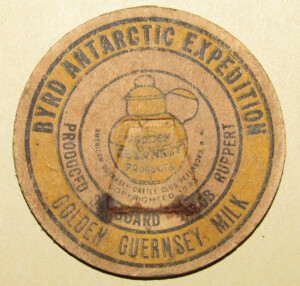 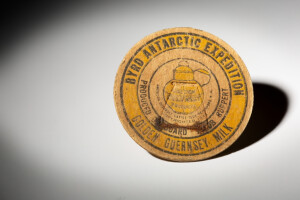 | NOTES: Milk bottle cap from milk that was produced on board the Jacob Ruppert. Item came from Mr. James M. Gillies, Chief Engineer on the Jacob Ruppert during Byrd's second Antarctic expedition. ADDITIONAL INFORMATION: [Teresa Steer, Peterborough Historical Society Staff, 2003, and Paul Doucette, Southborough Historical Society, at www.southboroughhistory.org.] On October 7, 1933, in preparing for an exploration of Antarctica, Admiral Richard E. Byrd asked for three Guernsey cows to go on the voyage in order that the crew might have fresh milk. Cows from Deerfoot Farms, Southborough, and Emmadine Farm, Hopewell Junction, New York (owned by J.C. Penney), were loaded on the ship Jacob Ruppert in Boston (Pier 9 at the navy yard in the Charlestown section). The ship set sail for Norfolk, Virginia, on October 11, 1933, to pick up coal and its other distinguished passenger, Nira Pola, another Guernsey cow from Klondike Farms in Elkin, North Carolina. Nira Pola was with calf, and Admiral Byrd thought it would be a novelty if a calf was born on the ice. The Jacob Ruppert set sail from Norfolk on October 22, 1933, for her journey to the Antarctic. Brought along for the cows were provisions of sand and straw for bedding, twenty tons of hay, twelve tons of beet pulp, and two tons of bran for their planned two years in the Antarctic. Printed for the expedition were milk bottle caps that read: "Byrd Antarctic Expedition, Golden Guernsey Milk Produced on Board the Jacob Ruppert." The three Guernsey cows - affectionately named "Deerfoot" ("Deerfoot Maid" or "Deerfoot Farm Maid" was her full name), "Foremost Southern Girl," and "Nira Pola Guernsey" or "Klondike Nira" - made the voyage to the Antarctic having gotten their sea legs long before any of the crew. A baby bull calf, named "Iceberg," was born to Klondike Nira 275 miles north of the Antarctic Circle on December 19th; Admiral Byrd had hoped that the birth would truly be an Antarctic event but, alas, it was not meant to be. The Original Ice Cream The Jacob Ruppert anchored in the Bay of Whales on January 17, 1934. Put ashore, the cows and the bull calf born at sea had to walk almost three miles across the ice to "Little America" before they were housed temporarily in a tent. The four cows lived onsite in the tent until a cow barn was made out of blocks of ice (15 x 31 x 8 feet). It was completed with an electric milking machine that awaited them at the site. Sadly, Klondike Nira contracted frostbite and had to be destroyed. The crew's attachment to the cows was very apparent when Cox (the crewman assigned to carry out the deed) is quoted in Admiral Byrd’s book, The Discovery, "I've put away a lot of 'em, Admiral, but it never got me before. I guess I got pretty fond of that cow". In 1935, the three remaining cows returned from the Antarctic after traveling 22,000 miles back to their original owners, going down in history as the first (and only) cows to travel to the Antarctic. | CL7458 | |||||||
| 8 | 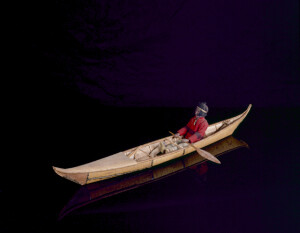 | Text from Bark Canoes The Art and Obsession of Tappan Adney by John Jennings, page 94: Upper Yukon Gwich’in Birchbark Hunting Canoe Based on Adney’s detailed drawings of this type of canoe when he was in the Klondike in 1897-98. The Gwich’in canoes are unique among Northwestern canoes in having a rigid frame, with the stringers held in place by crosspieces. Adney has used blocks between he stringers, but in a real canoe, the crosspiece would have been one piece of wood. The double gunwales of spruce are held together by continuous lashing. Each pair of gunwales is a single piece which has been split along it entire length, except at the ends, where the two gunwales are lashed together with rawhide. This would take great craftsmanship. The bow deck is completely floating, held only by the strong reverse curl of the bark. The elegant raking stems are unique to the Gwich’in. These canoes were extremely light and fast. An 1869 sketch by Frederick Whymper shows a Gwich’in hunter leaning out of his canoe and killing a moose with a knife, while steering with his other hand. NOTES: Birchbark kayak of the Kutchin Indians of the Upper and middle Yukon; from drawings by E.T. Adney at Klondike, 1898. There is a penciled arrow on bottom of canoe. Possibly denotes directions figure should be placed. Direction of arrow is away from "covered" end of canoe. ADDITIONAL INFORMATION: Adney, Tappan. The Klondike Stampede. Harper & Brothers Publishers. 1900. (F931 A23) INVENTORY: Doll, knife and sheath, axe, two (2) poles, paddle and seat - there are seven (7) component parts. | CL14390 | |||||||
| 9 | No image URL. | Alaska; Klondike River Valley (Yukon)–Gold discoveries | Through the gold fields of Alaska to Bering Straits | LB12794 | ||||||
| 10 | 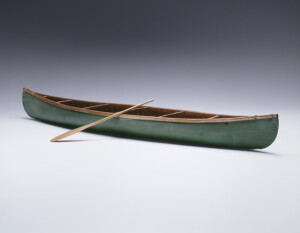 | INVENTORY: Paddle - there is one (1) component part. NOTES: Malecite canvas canoe of period 1890-1900, canvas substituted for bark, building technique unchanged. Later, the Indians at Passamaquoddy built as a boat, covering it with canvas, the modern canvas canoe. ADDITIONAL INFORMATION: Adney, Tappan. "News of the Klondike". Harper's Weekly. July - December 1898. pages 841-846. | CL14368 | |||||||
| 11 | No image URL. | Northwest Coast of North America.; China–Commerce.; Klondike River Valley (Yukon)–Gold discoveries. | Fur trade–Northwest Coast of North America.; Russians–North America. | Pathfinders in the North Pacific __ __drawings by Arthur Price | LB11075 | |||||
| 12 | No image URL. | Hudson's Bay Company. | Indians of North America–Boats–History; Canoes and canoeing–Models.; Canoes and canoeing–Design and construction.; Boatbuilding–History–North America; Indians of North America–Canada.; Indians of North America–Northeastern States.; Indians of North America–Great Lakes Region (North America).; Indians of North America–Great Plains.; Indians of North America–Northwest, Pacific.; Gold mines and mining–Alaska. | This collection features the research material of Edwin Tappan Adney (1868-1950) on the history, use, and construction of the bark canoe. Adney is regarded as a principal authority on the origins, development, and demise of bark canoes of North America. It spans from circa 1897 through 1949 and includes Adney's manuscripts, notes, correspondence, drawings, photographs, clippings, and templates. The primary areas of focus of this collection include materials and tools used; construction and decoration techniques; forms and uses; and bark canoes' functions within and significance to Native American culture. However, it also includes information on Native American migrations and languages as well as the origins and uses of small watercraft in Africa, Asia, Europe, and Oceania. Adney's contributions to the fields of bark canoe research and Native American history are invaluable. His research is exhaustive and detail-oriented. His drawings and models are both artistic and accurate. For these reasons, Adney's work remains highly regarded and is frequently referenced by scholars and authors. Additional material by Adney is held by other institutions. His collection of more than 100 canoe models is at The Mariners' Museum. His work on heraldry and Native American ethnography and linguistics is at the Peabody Essex Museum in Salem, Massachusetts. His work based on his travels to the Klondike is at Dartmouth College in Hanover, New Hampshire. The Edwin Tappan Adney Papers were formally processed in 2003-2004. Three primary objectives were achieved. The first objective relates to preservation. The collection was rehoused in protective archival materials and stored in a temperature- and humidity controlled environment. These measures minimize deterioration and increase life expectancy. The second objective relates to organization. The collection, once dispersed and scrambled, was arranged into logical and standardized series and sub-series. The third objective relates to access. A detailed finding aid was created and added to the Library's online catalog. Preservation of and access to the Edwin Tappan Adney Papers were made possible through a grant from the National Endowment for the Humanities. | MS0020 | |||||
| 13 |   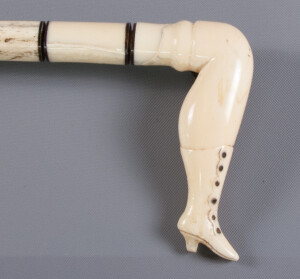 | SHORT DESCRIPTION: Whale bone cane, thin shaft, brass ferrule at tip, two part walrus ivory handle separated by pairs of thin baleen disks. Handle carved in shape of woman's lower leg, bent 90 degrees at knee. Woman's boot has six tiny baleen inlays simulating fastenings. Ivory portions of handle have check marks. NOTES: The cane was given to Mr. Hal E. Scott (Harold Elmer Scott) about 1921 or 1922 by Mrs. Carrie Monroe of Phoebus, Virginia who died there in 1933, age 84. Mrs. Monroe, in her younger days had been a variety actress, doing a Dutch dialect act and while performing in a frontier town on the West Coast. Mr. Scott was told by Ms. Monroe that she was presented with the cane by an admirer, the Captain of a whaling ship. The cane was carved by hand by one of the members of his crew. Mr. Scott's original letter indicates that Ms. Monroe was a vaudeville actress during the Klondike Gold Rush (1896-1898), but documents found refute this information. Ms. Monroe was married to Mr. James Davin, an actor, in 1892 and they lived in Pheobus. Ms. Monroe owned the Chesapeake Hotel from circa 1892 until 1905. A letter at the New York Public Library confirms that Ms. Monroe was in Pheobus in 1898. | CL2650 | |||||||
| 14 | 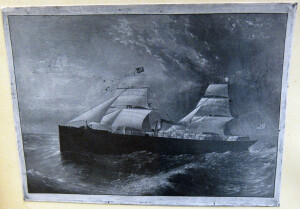 | VESSEL INFORMATION - VESSEL NAME: OHIO VESSEL TYPE: AMERICAN IRON SCREW BRIG SHIP BUILDER: WM. CRAMP AND SONS BUILDER LOCATION: PHILADELPHIA, PENNSYLVANIA SERVICE DATES: 1873-1909 SHIP OWNERS; AMERICAN STEAMSHIP CO. OF PHILADELPHIA VESSEL DIMENSIONS: 3,392 T.; 343'x43'x24'7" VESSEL HISTORY: She was built for Philadelphia and Liverpool service. In 1887, she was reconstructed and received new engines as quoted above, and on her trial did 14.12 knots. She was the first Atlantic liner to be sent on a yachting cruise to the West Indies. During the Gold Rush to the Klondike in 1898, she and her consorts were transferred to a subsidiary company known as the Empire Transportation Company, and placed in service between Seattle and Yukon. During the Spanish-American War, she was used as a transport and in 1900 for service during the Boxer Rising in China. In 1904, she was badly damaged by fire at Seattle. The following year she was sold to the White Star Line, an American organization for continued Pacific service. In 1908, she was badly damaged by ice in Alaskan waters and in August 1909, foundered off the coast of Alaska, having struck a rock. Five lives were lost including her wireless operator who did much in his line of duty. NOTES: Painting is on metal. Piece will be stored in a box or cardboard folder to protect it from bending. | CL4572 | |||||||
| 15 | No image URL. | NOTES: "Steamboat Bill", June 1948, p. 36.: "...(sold) in 1900 for trading to Cape Nome. After a few years hwe was fitted out as the whaler HERMAN, owned by Herman Liebes of San Francisco, and she went to the Bering Straits whale fishery regularly from 1907 to 1912. In 1913 she was laid up, but in 1914 was sent North in search of the ill-fated KARLUK of Steffanson's expedition, and also took 6 bow-head whales...In 1916 HERMAN was given an Atlas gas engine in place of her steam plant and rerigged as a baldheaded three-masted schooner, and in 1922 she was sold to G. Omana of La Paz, Lower California, who renamed her CHAPULTEPEC. She is out of the registers for 1928...She had a compound engine from Goss Marine Iron Works of Bath, Maine, and her mizen lower mast served as a smokestack."("Log Chips", Sept. 1948.). Vessel Database research by Arnold H. Janot (9-2-09) using the Lloyd's Register indicates some inaccuracies in the above "Steamboat Bill" account. The American Board of Commissioners for Foreign Missions owned MORNING STAR from 1884 to 1901, selling the vessel to Alaska Exploration Co. in 1901. Alaska Exploration Co. sold MORNING STAR to Herman Liebes & Co. in 1902. Herman Liebes renamed the vessel HERMAN in 1905. Herman Liebes sold HERMAN to G. Omana of La Paz, Mexico in 1926, was renamed CHAPULTEPEC, and was off the register in 1928. The vessel was always listed in the register as a wood auxiliary screw barkentine until CHAPULTEPEC was listed as a wood auxiliary screw brigantine either in error or by a rig change. VESSEL INFORMATION-- VESSEL NAME: MORNING STAR IV VESSEL TYPE: screw barkentine SERVICE DATES: 1884-1927 BUILDER LOCATION: Bath, Maine CAPTAINS OR OTHER RELATED PEOPLE: SHIP OWNERS: New England Shipbuilding Co. ENGINE BUILDER AND LOCATION: Goss Marine Iron Works of Bath Maine VESSEL DIMENSIONS: 471 gross tons, 290 net tons; 131'3" x 29'9" x 12'2" REGISTRY NUMBER: #91705 RELATED VESSELS: Massachusetts, Boston ALL SHIP NAMES: (1) MORNING STAR (1884-1905) (2) HERMAN (1905-1926) (3) CHAPULTEPEC (1927) VESSEL HISTORY: Morning Star was a steam auxiliary barkentine built at Bath, Maine, in 1884 where she had been launched on August 6, 1884. She was famous for her hollow mainmast which emitted steam and smoke from her auxiliary engine. She served as a missionary vessel for the American Board of Foreign Missions in the South Pacific until 1900, when she was sold to become a merchant ship. Her first such trip took her to Klondike from where she returned to San Francisco with $1 million worth of gold. | CL18727 | |||||||
| 16 | 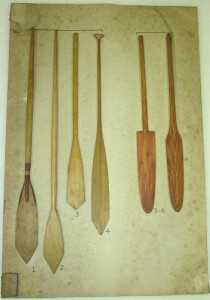   | SHORT DESCRIPTION: Paddle sample. Paddle is unpainted and undecorated. The tip of the blade is triangular in shape. Adney describes this paddle as one from the northern part of British Columbia: Small paddle with a moosehide canoe on bank of Yukon 1898 that had come down with Indians from upper reaches of that river to Dawson. NOTES: The items associated with 2000.38 were produced by Edwin Tappan Adney to illustrate a manuscript on the history, development and manufacture of bark canoes in North America. The bark decoration samples and paddle samples were mounted to paper in groups. When found they were extremely dirty and water stained. The mounting papers and backing boards were extremely brittle. To help preserve the samples they were removed from their decaying mounts, photo-documented and accessioned in a way that preserved the groupings that Adney created. Whenever possible the mounts were saved. | CL29488 | |||||||
| 17 | 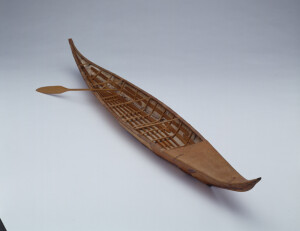 | NOTE: Text from Bark Canoes The Art and Obsession of Tappan Adney by John Jennings, page 95: Tanana River Gwich’in Birchbark Canoe, Based on a canoe at Nuklahayet, Yukon River, which Adney saw and sketched in 1898. The Tanana River is a tributary of the Yukon. Adney built this model in 1932. It is very similar to the previous model [MP 63]. These canoes were subtly asymmetrical, being slightly wider and deeper at the stern, thus making them both very fast and easy to maneuver. The lightness of the bow allows it to hydroplane when driven hard. This asymmetry is foreign to all other traditional canoe designs, but central to that of kayaks. The craftsmanship in these canoes was extraordinary. When, as the last element in building, the stempiece is fitted into the socket at the end of the bottom frame and the ribs are pushed down on the slightly hogged floor frame, the result is the rising of the stems like an elegant bird taking flight. NOTES: Original canoe 19 feet long, 27 inches wide, 10 inches deep, equipped with dipnet for taking salmon. Model complete with bark basket, large net, one oar, and two poles. INVENTORY: net, paddle and two (2) poles - there are four (4) component parts. | CL14410 |
Created 2026 by Don Barker, CBMM volunteer, for the Chesapeake Shipbuilding Project. shipbuilding@sailingworkboats.es